" Chiisana Hoshi " & " Beautiful People
| 小さな星 | |
 | 奥華子 あおい吉勇 ポニーキャニオン 2006-11-29 売り上げランキング : 377 おすすめ平均  アレンジ過剰でしょうか アレンジ過剰でしょうかAmazonで詳しく見る by G-Tools |
Yesterday , my favorite musician , Hanako Oku , has released the new CD , named " Chiisana Hoshi " . I hope you're going to buy it . Little by little , she is getting popular , so I think this CD is suppose to get the high sails .
| Beautiful People | |
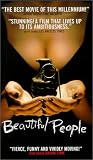 | Faruk Pruti Thomas Goodridge Tony Peters (II) Vidmark/Trimark 2000-06-27 売り上げランキング : Amazonで詳しく見る by G-Tools |
By the way , yesterday , I watched the movie named " Beautiful People " , and that was quite interesting . To be honest , it was really hard for me to understand the movie , because , first of all, the movie was from the UK . This means the actors speak the British English in the movie , and that means it is hard for me to understand it .
And the topic and the composition are really complicated , so that's made me confused pretty much . The main topic is about the confliction between the people in the UK . And that confliction is highly related to the Bosnia or Yugosulvia , so that requires me to have the background of the complex history in the east europe . And that is also quite hard , eh ?
And this movie is kind of comedy ( very , very black comedy , though ) . Understand the joke of the different countries is incredibly difficult . For example , " Rushmore " is considered the very funny comedy in the north america , but , for me , it is almost impossible to laugh at the joke in this movie . The joke always requires the viewers to have a certain type of the background , so , you know , understanding it is quite hard , eh ?
Anyway , I'm going to watch this movie again , and , paste the interesting interpritation of this movie below this blog . So , please watch this movie and read this interpritation .
With Beautiful People, first-time director Jasmin Dizdar has accomplished what few filmmakers are capable of - taking a serious subject and crafting an effective comedy from it that is defined by rich characters, genuine laughs, and an unpredictable plot. The key aspect of Beautiful People illustrates how the Bosnian conflict reaches into the streets and homes of the melting pot that is modern-day London. Many citizens of the former Yugoslavia (including Dizdar) have emigrated to England, and Beautiful People shows the kind of lifestyle they find there and how they interact with the established population, many of whom find their ways and traditions to be unfathomable.
Although the film is undeniably a black comedy, it tackles several serious issues. In what can only be viewed as a change-of-pace for movies about Bosnia and Bosnians, it has a generally upbeat perspective. While recognizing the tragedy inherent in the current conflict, Dizdar chooses not to dwell upon it. Instead, he focuses on the absurdities and ironies that the civil war has created, and how the situation has allowed some people to find the strength and courage to live a better life. Beautiful People is about men and women of different cultures coming together.
The film has an ambitious agenda. With a structure that bears a fleeting resemblance to Short Cuts or Magnolia, Beautiful People tells six stories that are often separate, but occasionally intersect, merge, or break apart. Each of these tales has at least one connection to the people or events currently transpiring in war-torn Bosnia. Some are richer and more substantive than others, but Dizdar works hard to ensure that they all hold our interest. The only problem with his approach is that it necessitates the passing of roughly a third of the film before the viewer has become immersed in Dizdar's world. It takes about 30 minutes for all of the characters, their relationships, and their situations to be established, and, during that initial period, some confusion is inevitable.
Beautiful People opens by introducing us to a Serb (Dado Jehan) and a Croat (Faruk Prutti) who encounter each other on a London bus. Fisticuffs break out, and the two end up brawling their way through the city's streets, eventually ending up in the same hospital room, recovering from their wounds. Meanwhile, another former Yugoslavian, ex-basketball player Pero (Edin Dzandzanovic), is brought to the hospital after being struck by a car. A nurse, Portia (Charlotte Coleman), falls in love with him, and, after his release, brings him home to meet her upper crusty family. A doctor (Nicholas Farrell) is distressed over the break-up of his marriage and the likelihood that his wife will take away his two children. Despite that, he does his best to help a pregnant woman and her husband come to grips with the harsh reality that the child she is about to give birth to is the product of a rape that happened before they left Bosnia.
Perhaps the film's most penetrating and ironic story is that of Griffin Midge (Danny Nussbaum), a loser whose only apparent goals in life are to sponge off his parents for as long as possible and remain in a drug-induced stupor. He doesn't go anywhere without his heroin. One day, Griffin is at the airport, ready to go to Holland to pick up some more drugs, when he falls asleep under a convenient tarpaulin. Unbeknownst to him, his resting place is actually a crate that is part of a relief shipment bound for Bosnia. When he wakes up, he is on the ground in the middle of a battle zone. He stumbles around until he encounters a BBC reporter, Jerry Higgins (Gilbert Martin), then uses his heroin to help a badly injured man endure an amputation. Griffin returns home as something of a minor hero, with a blind orphan in tow. Jerry, on the other hand, suffers a case of "Bosnia syndrome" that has him empathizing so deeply with the amputee that he wants his own leg to be removed.
There are a few occasions when Dizdar's symbolism becomes a little too obvious. For example, there's a scene in the hospital when a nurse picks up slippers worn by the Serb and Croat. After holding them up and inspecting them, she remarks that they are "exactly the same." For the most part, Beautiful People avoids this kind of obviousness, just as it steers clear of the flavors of heavy drama that have characterized a number of powerful motion pictures about this region of Europe.
It's worth noting that the perspective embraced by Beautiful People offers North American viewers an opportunity to see events from a closer vantage point. In this part of the world, Bosnia is a remote place, separated from us not only by differences in culture but by half a globe's distance. However, in London, the travel time is not as great and the circumstances are far less remote. Although, as Dizdar points out on more than one occasion, there are members of British society who would prefer to ignore the existence of any problems associated with the former Yugoslavia. (As if to prove his political awareness, one character comments with complete assurance, "I for one am opposed to ethnic cleansing.")
After appearing as an Un Certain Regard entry in the 1999 Cannes Film Festival, Beautiful People received international acclaim through film festival screenings and during its regular U.K. release (the screenplay was nominated for a British Independent Film Award). However, the most impressive thing about this film is not the recognition it has received, but the accessibility of the humor. While Beautiful People is best described as a black comedy (in an interview with Nick Roddick, Dizdar claims to have "a sense of humour so black it's intolerable"), it is funny, not merely grimly amusing. This makes Beautiful People one of the most intriguing and thought-provoking comedies to reach U.S. theaters in early 2000.
posted by NINJA @ 1:17 PM


0 Comments:
Post a Comment
<< Home